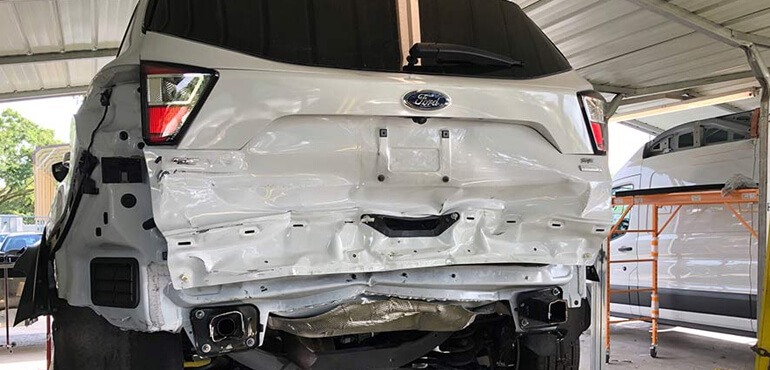

A garage telling you not to repair your car is unusual. It is also, sometimes, the most honest and useful thing anyone can say to you.
The commercial logic of most workshops runs in one direction: the car comes in, a fault is identified, a repair is proposed, revenue is generated. There is nothing wrong with that — it is how the business works, and most repairs that are proposed are entirely legitimate. But it creates a structural silence around a question that every owner of an older or high-mileage Mercedes will eventually face: is this repair actually worth doing?
It is a question that deserves a direct answer, and the answer is not always yes. There are circumstances where spending money on a repair is financially irrational — where the cost of the work, set against the value of the car and the likelihood of further costs following behind it, does not add up. There are circumstances where the right decision is to sell, to part-exchange, or in some cases to live with a fault rather than fix it. And there are circumstances where the repair is absolutely worth doing, but not for the reason most people assume.
This article sets out the framework for making that decision honestly.
The Question Nobody Asks at the Desk
When a repair is quoted, the conversation is almost always about the cost of the repair itself. It is rarely about what that repair means in the context of the car’s overall condition, age, value, and likely future costs.
That wider context is where the real decision lives.
A £1,200 repair on a Mercedes worth £18,000 is a straightforward decision in most cases — a reasonable cost to maintain a valuable asset that, well looked after, has many years of service ahead. The same £1,200 repair on a Mercedes worth £3,500 with 140,000 miles and a service history that shows the last three years of maintenance have been patchy is a different proposition entirely. The repair cost represents a third of the car’s value. The car’s condition suggests further costs are likely. And the question is no longer “can I afford the repair?” but “is this the best use of £1,200?”
Asking that question requires information that is not always volunteered: an honest assessment of what else is likely to need attention in the near term, a realistic view of the car’s market value, and a clear-eyed look at what the repair actually buys in terms of remaining reliable life.
The Repair-to-Value Ratio
The most commonly cited rule of thumb for repair decisions is the repair-to-value ratio: if the cost of a repair exceeds a certain percentage of the car’s current market value, the repair is difficult to justify on purely financial grounds.
The threshold varies by circumstance, but a repair costing more than 50% of the car’s value is a significant warning sign. A repair costing more than the car’s value — which happens more often than it should, on older vehicles where major components fail — is almost never financially rational unless the car has non-financial value that overrides the calculation.
This ratio is not a hard rule. It is a prompt to think clearly. A car that is otherwise in excellent condition, with a strong service history and no other known issues, may be worth repairing even at a high ratio — because you know what you have, and the alternative is an unknown quantity. A car that has reached the same point via years of deferred maintenance and accumulated issues is a different case entirely.
The important adjustment to the ratio is the phrase “current market value” — not what you paid for it, not what you would like it to be worth, but what the car would actually sell for in its present condition, today. Emotional attachment to a purchase price that is several years in the past is one of the most consistent sources of poor repair decisions.
The Second Question: What Comes Next?
The repair-to-value ratio addresses the immediate decision. The second question addresses what follows it.
A car presenting one significant fault is often presenting the first fault that became undeniable — not the first fault in the car’s condition. An experienced technician looking at a high-mileage Mercedes that has come in for a major repair will typically be able to form a view on what else is in the queue: which other components are showing their age, which systems are marginal, what the service history suggests about what has and hasn’t been maintained.
That view should be part of the repair conversation. If a car needs a £900 turbocharger refurbishment and the technician can see that the gearbox fluid has never been changed, the fuel injectors are showing wear patterns, and the front suspension bushes are at the end of their life, the honest assessment is not “this turbo repair will fix the problem.” It is “this turbo repair will fix this problem, and here is what is likely to need attention within the next 12 to 18 months.”
Armed with that information, the owner can make a decision that accounts for the realistic total cost of bringing the car back to a good state, not just the cost of the immediate repair.
In some cases, that honest projection changes the decision. A car that needs £900 now and is likely to need a further £2,000 to £2,500 over the next year, against a market value of £5,000, is a car that is going to absorb a significant proportion of its own value in maintenance costs. That may still be the right decision — new cars are expensive, and known running costs are sometimes preferable to the uncertainty of something different — but it should be a conscious choice, not an uninformed one.
When Selling Makes More Sense
There is a point in the life of a high-mileage Mercedes at which selling is the better financial decision, and it arrives earlier than most owners instinctively feel.
The reason it arrives earlier than it feels is depreciation. A Mercedes that is worth £4,000 today may feel like it should have several more years of value because it cost £28,000 new. But the car’s future value is not determined by its past cost — it is determined by what someone will pay for it today and tomorrow. A car worth £4,000 now will be worth approximately £2,500 to £3,000 in two years if it remains in reasonable condition. Spending £2,000 on repairs to preserve a car whose value will fall by £1,000 to £1,500 regardless is a decision that needs to be examined, not assumed.
Selling is most clearly the better option when:
The repair cost represents more than 40% to 50% of the car’s current market value, and the repair is not the only item the car needs. The combination of immediate and near-term costs makes the total maintenance spend over the next 12 months likely to approach or exceed the car’s value.
The car’s condition has reached a point where there is genuine uncertainty about what else is in the queue — where the service history is incomplete, the condition is variable, and there is no reliable baseline for what the car has and hasn’t had done.
The owner’s circumstances have changed in a way that makes the car’s ongoing reliability more important than it was previously — a new job with a longer commute, a change in family circumstances, a role where a breakdown would be genuinely costly.
In these circumstances, the equity in the car — even at a modest market value — is better deployed against something with a known condition, a current warranty, or at minimum a fresh service history, than absorbed into a repair programme on a car whose future costs cannot be predicted with confidence.
When Living With It Is Legitimate
Not every fault requires repair, and not every fault that doesn’t require repair should be ignored. Some faults occupy a middle ground: they are real, they affect the car in some way, and they do not need to be addressed urgently.
The test for whether a fault can legitimately be deferred has three parts.
Safety. Anything that affects the car’s ability to stop, steer, or signal correctly is not deferrable. Brake wear, suspension faults that affect handling, lighting failures — these require attention regardless of the cost calculation. Everything else is negotiable.
Progression. Some faults are stable — they exist, they may cause a minor symptom, and they will not become worse in the near term. Others are progressive — left unaddressed, they will develop into a larger and more expensive problem. A leaking rocker cover gasket that is dripping oil onto the exhaust is a nuisance and smells unpleasant, but it is stable. An engine that is burning oil because of a failing turbocharger oil seal is progressive — the turbocharger is degrading, the catalytic converter is being contaminated, and the interval between “manageable” and “serious” is measured in months, not years.
Cost of progression. If a fault that costs £300 to fix now will cost £1,200 to fix in six months because associated components will also need replacing by then, deferral is false economy. If a fault that costs £300 to fix now will cost £320 in six months because nothing material changes, deferral is a genuine option.
The Fault That Is Actually a Feature
There is one specific category of “repair” that deserves its own mention: the fault that is real but that the owner has come to terms with.
A minor rattle that has been present for two years and has been investigated twice without a definitive cause. A very occasional hesitation at idle that the car does in cold weather and always has. A climate control button that stopped working on a car that otherwise functions perfectly.
These are not faults to be chased endlessly at significant cost. If a symptom has been properly investigated, the likely causes have been excluded, and the car is otherwise performing well, the decision to leave it and drive is a rational one. Not every car needs to be perfect. Chasing perfection on a high-mileage vehicle can become an exercise in diminishing returns that generates workshop invoices without generating satisfaction.
The judgment is in knowing which category a fault falls into — and that judgment requires either the experience to make it yourself or a technician whose honesty you trust enough to make it for you.
Why an Honest Garage Tells You This
The short-term commercial case for a garage is to recommend every repair on every car. The long-term commercial case is the opposite: to be the place that gives you an honest assessment, even when the honest assessment is “this isn’t worth fixing” or “you should sell this car.”
Owners who are told the truth — including difficult truths — come back. They refer people. They trust the advice they receive on the cars they own next, because the advice they received on the last one turned out to be right. The garage that tells a customer their repair isn’t worth doing loses one invoice and gains a relationship that is worth considerably more.
That is the calculation behind this article. Not every Mercedes repair is worth doing. Knowing which ones aren’t is part of what makes advice worth taking.
MB Wirral are Mercedes-Benz specialists on the Wirral. If you’ve been quoted a repair and you’re not sure whether it makes sense, bring it to us for a second opinion — or just an honest conversation about your options.


