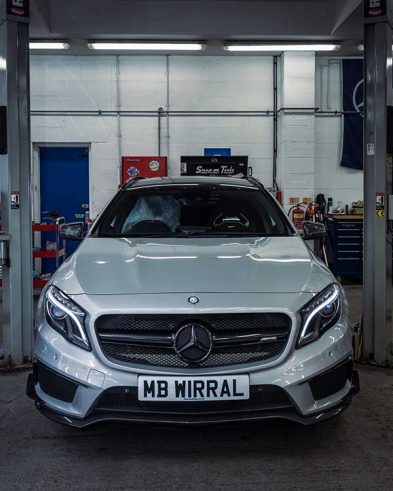

Drive around Wirral for long enough and you’ll spot them — Mercedes models well past 150,000 miles, still running smoothly, still being trusted for the school run, the motorway commute, or the occasional long trip without a second thought. These cars aren’t lucky. With very few exceptions, a Mercedes that reaches 200,000 miles and beyond got there because someone made a series of small, consistent decisions over its lifetime, not because of any one secret trick.
Mercedes-Benz builds its cars to last. The engineering tolerances, the quality of materials, and the engineering philosophy behind models like the C-Class and E-Class are all designed with long-term durability in mind. But that potential only gets realised with the right habits behind the wheel and the right approach to maintenance. Here’s what separates the Mercedes owners who get there from those who don’t.
Warm-Up Habits Matter More Than You’d Think
It’s tempting, especially on a cold Wirral morning, to start the engine and pull straight away. Most modern engines are designed to cope with this reasonably well, but “cope with” and “ideal for longevity” aren’t the same thing.
When an engine is cold, oil is thicker and takes longer to reach every component that needs lubrication, particularly the upper parts of the engine like the camshafts and valve train. Driving hard before the oil has properly circulated and warmed increases wear on these components, especially over hundreds or thousands of repeated cold starts across a car’s life.
Good habits to build in:
- Give the engine 30–60 seconds after starting before pulling away, rather than revving immediately
- Drive gently for the first five minutes or so, avoiding hard acceleration until the temperature gauge shows the engine has started to warm
- Avoid short journeys where possible, particularly with diesel engines, since the engine barely reaches operating temperature before it’s switched off again
- In winter, resist the urge to sit idling for ten minutes to “warm up” — gentle driving warms the engine faster and more evenly than idling does
None of this is dramatic, and it costs nothing. But multiplied across tens of thousands of cold starts over a car’s life, it makes a measurable difference to wear on the engine’s internals.
Gearbox Servicing: The Step Owners Skip Most
If there’s one piece of maintenance that gets neglected more than any other on a used Mercedes, it’s transmission servicing. The persistent myth that automatic gearboxes are “sealed for life” has cost plenty of owners an expensive gearbox rebuild that proper servicing would have prevented.
Mercedes’ 7G-Tronic and 9G-Tronic automatic gearboxes are well engineered, but the fluid inside degrades over time and mileage, losing its ability to lubricate and protect internal components properly. Mercedes does specify service intervals for this fluid, even if it’s not always advertised loudly.
What proper gearbox care looks like:
- A transmission fluid and filter change at the intervals recommended for your specific model — typically somewhere in the region of every 40,000–60,000 miles, though this varies by model and should be confirmed with a specialist
- Using the correct specification fluid, since the wrong fluid type can cause shifting problems even if it’s “close enough” on paper
- Paying attention to early signs of wear — hesitation when pulling away, harsh shifts between first and second gear, or whining noises — and getting them checked rather than waiting for them to worsen
A gearbox service is a relatively modest cost compared with the alternative. A full automatic gearbox replacement is one of the most expensive single repairs a Mercedes owner can face, and it’s almost always preventable with proper fluid maintenance.
Preventive Maintenance Beats Reactive Repairs
The owners who get the most out of their Mercedes tend to think about maintenance differently from the start. Rather than waiting for something to go wrong and then fixing it, they treat servicing as a way of catching small issues before they become big ones.
This looks like:
- Sticking to manufacturer-recommended service intervals, not stretching them to save money in the short term
- Having brake fluid, coolant, and other fluids changed on schedule, even though they don’t fail dramatically the way an engine or gearbox might
- Asking a specialist to inspect commonly worn items — bushes, suspension components, belts and hoses — during routine services rather than only when a fault appears
- Keeping a full, documented service history, which not only helps a mechanic spot patterns over time but also protects the car’s value if you ever sell it
There’s a meaningful difference between a car that’s been serviced reactively, fixed only when something visibly breaks, and one that’s been maintained proactively. The second car tends to have fewer expensive failures, simply because problems get caught at the cheap-to-fix stage rather than the expensive-to-fix stage.
Avoiding Cheap Parts
Cost-cutting on parts is one of the most common false economies in Mercedes ownership. It’s understandable — genuine or high-quality OEM-equivalent parts cost more upfront than budget alternatives — but the gap in quality often shows up exactly where it matters most.
Where this matters most:
- Oil and filters — using the correct specification oil (Mercedes has specific approvals for a reason) protects the engine far better than a cheaper, incorrect-spec alternative
- Brake pads and discs — budget pads can wear discs faster, generate more brake dust, and in some cases perform less consistently under heavy braking
- Suspension components — cheap aftermarket bushes and arms often wear out far sooner than quality equivalents, meaning you end up paying for the labour to replace them twice
- Sensors and electrical parts — Mercedes’ electronics are tightly integrated, and poor-quality replacement sensors can trigger fault codes or behave inconsistently in ways that are hard to diagnose later
This doesn’t mean every part needs to be a genuine Mercedes-Benz component at full dealer price — there are excellent quality aftermarket and OEM-equivalent parts available that perform just as well for less. The key is working with someone who knows which parts are worth paying more for and which aren’t, rather than defaulting to the cheapest option across the board.
Early Diagnostics: Catching Problems Before They Escalate
Perhaps the single biggest factor separating a Mercedes that reaches 200,000 miles from one that doesn’t is how quickly small issues get addressed. Almost every expensive Mercedes repair started as a minor, inexpensive-to-fix symptom that was ignored for too long.
Some examples worth taking seriously the moment they appear:
- A faint rattle on cold start-up — often an early timing chain or tensioner symptom, cheap to address early, expensive if ignored
- A dashboard warning light, even one that clears itself — modern Mercedes models log fault codes that a specialist can read even after the light has gone out, and these often reveal developing issues
- A small drop in ride height overnight — usually the first sign of an air suspension leak, far cheaper to fix as a single strut than as a strut plus a burned-out compressor
- Slightly delayed gear engagement — an early gearbox fluid or sensor issue that’s inexpensive to investigate while it’s still minor
This is where proper diagnostic equipment matters. Mercedes vehicles use sophisticated onboard systems, and a specialist with the right diagnostic tools can often identify a developing fault weeks or months before it becomes a noticeable problem, let alone a breakdown. A five-minute scan during a routine service can save thousands of pounds and considerable inconvenience down the line.
The Real Secret: Consistency, Not Perfection
None of the habits above are complicated or expensive on their own. Warming the engine gently, servicing the gearbox on schedule, choosing decent-quality parts, and addressing small issues promptly — these are all manageable, ordinary decisions. What makes the difference is doing them consistently, year after year, rather than occasionally when it’s convenient.
A Mercedes that reaches 200,000 miles isn’t the result of luck or an unusually robust individual car. It’s the result of an owner, and often a trusted specialist, paying attention to the small things over a long period of time.
If you’d like a clear picture of where your Mercedes currently stands and what it needs to go the distance, our team across Wirral has helped plenty of owners get well past the 100,000-mile mark and keep going. Book a health check with us and we’ll give you an honest assessment — no upselling, just the information you need to look after your car properly for years to come.


