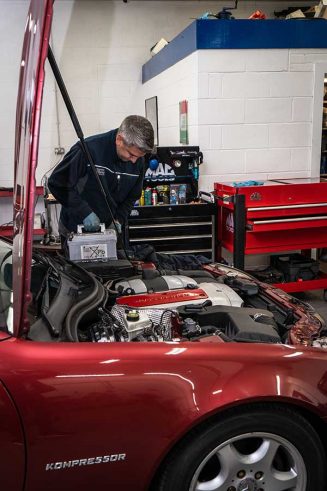

Nobody enjoys MOT day, and it’s made worse when a failure catches you off guard for something that, in hindsight, was entirely avoidable. Having tested hundreds of Mercedes models over the years, we tend to see the same handful of issues coming up again and again — most of which are cheap and quick to sort out if they’re caught before the test, rather than during it.
Lighting faults: the single most common failure point
Blown bulbs, misted or cracked lenses, and incorrectly aimed headlights are consistently among the most frequent reasons any car fails its MOT, and Mercedes models are no exception. The frustrating part is how easily avoidable this is — a five-minute check of every light, indicator, brake light, and number plate light before the test can save an automatic fail. Xenon and LED headlight units on some Mercedes models can also fail their aim test if the self-levelling system has developed a fault, which is worth knowing if a light failure comes back as an aim issue rather than a bulb.
Tyres: tread depth, damage, and age
Tyres are another leading cause of failure, and not always for the reason owners expect. Beyond the legal minimum tread depth of 1.6mm, testers are also checking for cuts, bulges, and uneven wear patterns that can indicate a wheel alignment or suspension problem. Uneven wear across the front tyres in particular is often a sign of tracking that’s drifted out over time, something worth having checked before it costs you a set of tyres as well as an MOT pass.
Brakes: pads, discs, and fluid condition
Brake performance is tested both visually and on a rolling road, checking for even braking force across each axle. Worn pads, scored or corroded discs, and brake fluid that’s absorbed too much moisture over time can all cause a fail. This is one area where Wirral’s coastal air plays a role too, since corrosion on brake lines and calipers can develop faster here than inland.
Suspension and steering components
Play in ball joints, worn bushes, or a leaking shock absorber can all result in a fail, and these are exactly the kind of faults that develop gradually enough that an owner might not notice them day to day. A knock over speed bumps or a vague feeling through the steering wheel is often the first clue something in the suspension needs attention.
Emissions
For diesel models particularly, emissions testing has become stricter, and a partially blocked DPF, a developing AdBlue issue, or an underlying engine fault can all cause a smoke or emissions test failure. This is one area where a pre-MOT check with proper diagnostic equipment is genuinely worth doing, since an emissions fail on the day itself, with no time to investigate, can leave you without a car until it’s resolved.
The value of a pre-MOT check
Every one of the issues above is either free or inexpensive to fix if it’s caught in advance — a bulb, a bit of tracking, a set of pads. Caught during the test itself, with the car already booked in and potentially off the road, it’s a lot more stressful. At MB Wirral, we’re a certified MOT centre and happy to run through a pre-MOT check alongside a routine service, so nothing catches you out on the day.


