
Most warning lights get ignored. Not out of recklessness — out of hope.
The light comes on. Nothing immediately changes. The car drives the same. There’s no noise, no smoke, no obvious sign that anything is wrong. The light is amber, not red. You’ve got a busy week. You’ll get it looked at soon. And then soon becomes a fortnight, and a fortnight becomes two months, and the light has been on long enough that it’s become part of the dashboard furniture — registered but no longer prompting action.
This is one of the most common patterns in car ownership, and on a modern Mercedes it is one of the most expensive. Not because warning lights always signal imminent disaster — most don’t. But because the systems that illuminate those lights are connected to other systems, and the fault that triggered the light is rarely static. It develops. The components affected continue to operate under stress. Other components downstream begin to carry consequences they weren’t designed for.
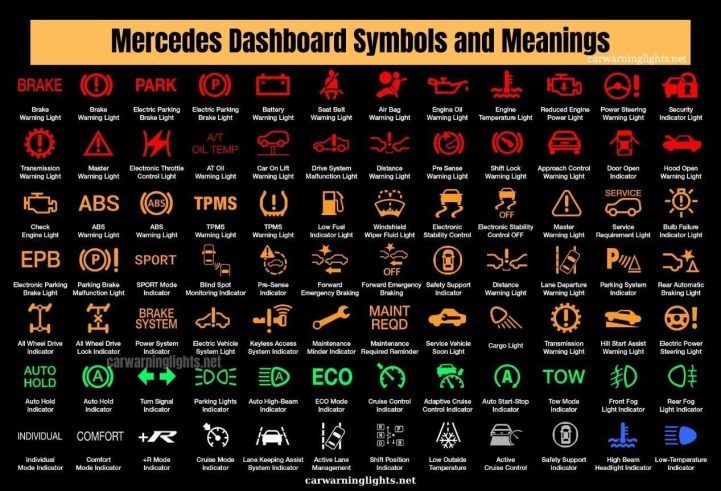
What follows is a concrete account of what actually happens — on a realistic timeline — when four of the most commonly ignored warning lights on a Mercedes are left unaddressed. Not worst-case scenarios. Typical ones.
1. The Engine Management Light (Amber)
Week one. The engine management light illuminates. The car seems to be running normally. There’s perhaps a very slight flatness under hard acceleration, or maybe nothing perceptible at all. The light is amber — the universal signal for “this needs attention, but not immediately.” You make a mental note to book it in.
Weeks two to four. The underlying fault — in this scenario, a misfire on one cylinder caused by a failing ignition coil, one of the most common causes of an engine management light on Mercedes petrol engines — continues. Each ignition event on that cylinder either misfires completely or fires incompletely. Unburned fuel passes through the cylinder, past the exhaust valves, and into the exhaust stream.
That unburned fuel enters the catalytic converter, where it ignites. The converter is designed to handle a small, transient amount of unburned fuel — it is not designed to act as a combustion chamber for fuel that was not burned in the engine. The converter begins to run hotter than its design temperature. The ceramic substrate inside — the honeycomb structure that holds the catalytic materials — begins to accumulate thermal stress.
Month two. The misfire has been ongoing for six to eight weeks. The catalytic converter has been running hot throughout. The ceramic substrate begins to fracture internally. In some areas it begins to break down — a process called “melting” in severe cases, though the reality is a collapse of the internal structure that dramatically reduces the converter’s efficiency and, as fragments break off, creates a rattling sound that owners often describe as something loose under the car.
A replacement catalytic converter on a Mercedes petrol engine — a component that was perfectly functional before the ignition coil fault began — costs between £400 and £900 fitted. The ignition coil that caused the problem costs £80 to £150 to replace. The engine management light came on at week one.
The total cost of waiting: a repair that should have been £80–150 has become £500–1,050, and the car has been running in a degraded emissions state throughout.
2. The AdBlue / SCR Warning Light (Diesel)
Day one. The AdBlue warning light illuminates on a diesel Mercedes with a Selective Catalytic Reduction system — which covers most diesel models from approximately 2014 onwards. The light is informational at this stage: AdBlue levels are low, and a refill is required. The car will continue to operate normally.
Mercedes SCR systems are designed with a defined countdown from the first warning to engine lockout. The exact threshold varies by model and software version, but the structure is consistent: a first warning at approximately 2,400 km remaining range, escalating warnings as the threshold approaches, and at zero AdBlue range, the engine will not restart after the next shutdown. This is not a fault — it is legally mandated behaviour under emissions regulations.
Week two to four. The owner is aware of the light but has not refilled. The car is being driven daily. The countdown is running. The second warning escalates — the range counter is now visible on the instrument cluster and the warnings appear at each startup.
The moment of lockout. The car is parked at a supermarket, or outside a school, or in a company car park at 7:45 in the morning. It will not restart. Not because anything has failed, but because the system has reached its programmed limit and is doing precisely what it is designed to do. The owner has not been ambushed — they were warned, clearly and repeatedly, over a period of weeks.
The cost of AdBlue is approximately £1.50 per litre at most petrol stations and considerably less in bulk. A typical top-up to clear the warning is five to ten litres. The total cost of addressing the first warning on day one: under £15.
The total cost of waiting: a breakdown call-out if the car locks out away from home, a potentially significant inconvenience if it locks out at a critical moment, and the residual cost of whatever assistance is needed to get AdBlue into the car at the roadside. Plus the accumulated stress of watching the counter drop and deciding each morning whether today is the day.
AdBlue lockout is the purest example of a warning light that escalates not through mechanical failure but through the compounding consequences of a decision not to act.
3. The DPF Warning Light (Diesel)
Week one. The diesel particulate filter warning light illuminates. The filter has reached a soot loading threshold that requires regeneration — a burn-off cycle that clears the accumulated particulates. Under normal operating conditions, this regeneration happens automatically during extended higher-speed driving without the driver being aware of it. The warning light means this automatic process has not been completing, and the filter is now loaded beyond the point of passive regeneration.
The appropriate response at this stage is a sustained motorway or A-road drive at over 50 mph for thirty to forty-five minutes. In most cases, this is sufficient to trigger and complete a regeneration cycle, clear the soot loading, and extinguish the light. Cost: the fuel for a forty-minute drive.
Week two to three. The owner has continued driving the same short urban routes that caused the problem in the first place. Regeneration has not occurred. Soot loading continues to increase. A second, more urgent warning illuminates — on most Mercedes diesel models, this is accompanied by a reduction in engine performance as the ECU limits power output to reduce further soot loading. The car feels noticeably less powerful.
At this stage, passive regeneration is no longer possible. The filter is too loaded for a driving cycle to clear it. A forced regeneration — a process initiated and managed by a diagnostic tool that raises exhaust temperature under controlled conditions while the car is stationary — is now required. This is a workshop procedure, not a home remedy. Cost: approximately £80 to £150 at a specialist.
Month one to two. The forced regeneration has not been carried out. The car has been driven for several more weeks with the DPF in an increasingly loaded state. Some owners at this point attempt a “DPF cleaning additive” — a product that does not address a severely loaded filter and should not be treated as a substitute for proper regeneration.
The filter is now beyond forced regeneration. The soot loading has reached a level where the filter substrate is at risk of damage — extreme back pressure, and in some cases cracking of the ceramic substrate from thermal stress during partial or failed regeneration attempts. At this point, replacement of the DPF is the only option.
A DPF replacement on a current Mercedes diesel — including the filter unit, installation, and the fluid top-up required to reset the system — costs between £1,200 and £2,200 depending on the model.
The total cost of waiting: A forty-minute drive at week one. A £80–150 forced regeneration at week two. A £1,200–2,200 filter replacement at month two.
4. The Coolant Temperature Warning (Red)
This one is different from the others, because the red coolant temperature warning — the gauge climbing into the red zone, or the dedicated overtemperature warning — is not a light that can be ignored for weeks. It demands immediate action. It is included here not because owners routinely drive on for months with it, but because the escalation from ignoring it for even a short period is the most severe of any warning on this list.
The moment the red warning appears. Engine coolant temperature has exceeded its safe operating range. The most common cause on a Mercedes is a failed thermostat, a failing water pump, a coolant leak, or a blown head gasket allowing combustion gases into the cooling system.
The appropriate response is immediate: stop driving, turn off the engine, do not restart. Allow the engine to cool before investigating or calling for assistance.
If the driver continues for five to fifteen minutes. An engine running significantly above its operating temperature is experiencing thermal stress across every component. Aluminium cylinder heads expand at a different rate to cast iron or steel blocks. Gasket materials that are designed for stable operating temperatures are exposed to conditions outside their design range. Oil viscosity drops as temperature rises, reducing the lubricating film at bearing surfaces.
The likely outcome of sustained driving with a red coolant warning is a warped cylinder head — where the aluminium distorts under thermal stress and the head gasket seal fails. A head gasket replacement on a Mercedes four-cylinder engine is a significant undertaking: between £900 and £1,800 in labour and parts at a specialist, and more if the head itself has warped beyond resurfacing and requires replacement.
In the most severe cases — engines driven for extended periods in an overheated state — the damage extends to the cylinder bores, bearing surfaces, and pistons. At that point the discussion moves from a head gasket repair to an engine rebuild or replacement, with costs that can reach £4,000 to £8,000 or beyond.
The total cost of not stopping immediately: potentially the engine.
The Pattern Across All Four
Each of these scenarios follows the same structure. A warning appears at a point where the underlying issue is contained and the cost of addressing it is modest. Time passes. The fault continues. Secondary systems are affected. The window for the inexpensive intervention closes. The repair that was available at the beginning is no longer sufficient, and the repair that is now necessary is substantially more expensive.
Warning lights on a modern Mercedes are not conservative or overly sensitive. They are calibrated to illuminate at the point where the system detecting the fault has reached a threshold that its designers considered significant enough to communicate. They are not suggestions. They are the car’s account of its own condition, delivered as clearly as it can manage.
The question is not whether to take them seriously. It is how quickly.
MB Wirral are Mercedes-Benz specialists on the Wirral. If you have a warning light on and you’ve been putting off dealing with it, call us before the timeline moves on. The earlier we see it, the more options you have.


