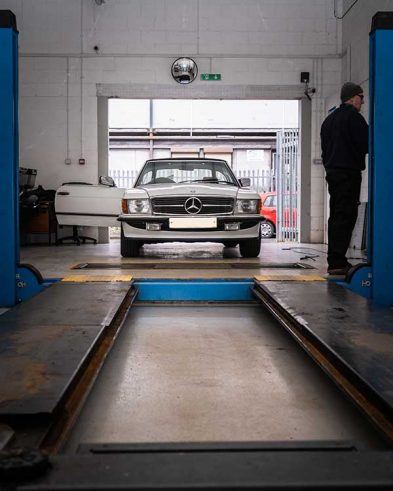

The sophisticated suspension and steering systems that deliver Mercedes-Benz’s renowned ride quality, precise handling, and confidence-inspiring road manners depend on dozens of components working in harmony—ball joints, control arms, bushings, shock absorbers, springs, tie rods, and steering linkages all contributing to the driving experience that attracted you to the Mercedes brand. These components wear gradually through thousands of miles of service, with degradation progressing from barely noticeable changes to obvious problems that compromise safety, handling, and comfort. The critical question for Mercedes owners is simple: how do you identify suspension and steering wear early, when repairs are straightforward and costs are modest, versus waiting until wear becomes severe requiring expensive multi-component replacement and potentially creating safety hazards?
For Mercedes owners across the Wirral, Cheshire, and surrounding areas, understanding early suspension wear symptoms saves substantial money while maintaining the vehicle performance you expect. The difference between catching worn suspension components at 50-60% deterioration versus waiting until complete failure can represent £500-£1,500 in avoided additional repair costs—worn components accelerate wear in related parts, while delayed repairs often damage adjacent components requiring replacement of entire assemblies rather than individual parts. More critically, severely worn suspension and steering components compromise braking performance, reduce emergency handling capability, and increase accident risk in situations where properly functioning suspension might prevent collisions.
This guide explains the specific symptoms indicating suspension and steering wear on Mercedes-Benz vehicles, interprets what different sounds, feel changes, and tire wear patterns actually mean, provides owner checks anyone can perform, and clarifies why early professional diagnosis and repair delivers far better value than deferred maintenance that seems to save money but ultimately costs more while compromising safety.
Understanding Mercedes Suspension Systems and Common Wear Points
Mercedes-Benz employs sophisticated suspension designs across their model range—from multi-link independent setups on C-Class and E-Class to advanced air suspension on S-Class and GLE models. While specific configurations vary, common wear points exist across all Mercedes suspension systems.
Control arm bushings connect control arms to vehicle chassis, allowing controlled movement while isolating road vibration. These rubber or polyurethane bushings deteriorate from age, environmental exposure, and mechanical stress. Worn bushings allow excessive movement creating wandering steering feel, poor wheel alignment retention, and uneven tire wear.
Mercedes control arm bushings typically show significant wear around 60,000-100,000 miles depending on driving conditions and maintenance. Urban driving with potholes and speed bumps accelerates wear compared to smooth motorway miles. Bushings are often available separately from control arms on some models but many modern Mercedes require complete control arm assembly replacement when bushings fail—this makes early detection economically important before bushing failure damages control arm mounting points.
Ball joints provide articulation points allowing steering while supporting vehicle weight. Upper and lower ball joints (depending on suspension design) wear from constant load cycling and steering movement. Worn ball joints develop play (looseness) that affects steering precision and creates knocking sounds over bumps.
Ball joint wear represents serious safety concern—severely worn ball joints can separate allowing wheel to collapse, causing loss of control and potential accident. Mercedes ball joints generally provide 80,000-120,000+ mile service but accelerated wear occurs with pothole impact, curb strikes, or inadequate lubrication (on older models with serviceable joints).
Shock absorbers (dampers) control spring oscillation maintaining tire contact with road surface. Mercedes uses various damper technologies—standard hydraulic, gas-charged, adaptive damping, and air suspension—each with specific wear characteristics. Worn dampers lose ability to control spring movement creating bouncy ride, poor body control, reduced braking performance, and accelerated tire wear.
Damper wear is gradual and insidious—you adapt to slowly degrading performance not noticing how much worse it’s become until fresh dampers reveal the difference. Mercedes dampers typically provide 60,000-100,000 miles service though air suspension components may require attention sooner. Failed dampers rarely fail catastrophically but degraded performance significantly affects vehicle safety and handling.
Tie rod ends and steering linkage connect steering rack to wheels translating steering input into wheel movement. These joints wear creating play (looseness) in steering, vague steering feel, wandering at motorway speeds, and potential alignment problems.
Worn tie rod ends represent safety concern similar to ball joints—severe wear can allow separation causing loss of steering control. These components typically last 80,000-150,000 miles but wear accelerates with poor road conditions or impact damage.
Anti-roll bar (sway bar) bushings and links control body roll during cornering. Worn bushings allow excessive movement creating clunking sounds over bumps and reduced cornering stability. These are among the most frequently replaced suspension components on higher-mileage Mercedes, often showing significant wear by 50,000-70,000 miles.
Anti-roll bar link replacement is relatively inexpensive (£100-£250 per side typically) making early replacement economically sensible. Deferred replacement causes links to fail completely, potentially damaging anti-roll bar or other components.
Air suspension components on S-Class, GLE, GLS, and some other models add complexity with air springs, height sensors, compressor, and air distribution systems. These systems provide exceptional ride quality but require specific maintenance and experience unique failure modes. Air spring leaks, compressor failure, height sensor faults, and valve block problems all occur creating various symptoms from ride height loss to warning lights and degraded ride quality.
Understanding these wear points enables targeted inspection and early identification when components begin degrading but haven’t yet failed completely.
Audible Symptoms: What Different Sounds Mean
Suspension and steering wear often announces itself through specific sounds providing diagnostic clues about which components are degrading.
Clunking Over Bumps
Characteristics: Distinct “clunk” or “knock” sound when driving over bumps, potholes, or rough surfaces. May occur from front, rear, or both depending on worn components.
Likely causes:
- Worn anti-roll bar links (very common)—sound occurs each time suspension moves, particularly over speed bumps or potholes
- Worn shock absorber mounts—top mounts deteriorate allowing damper to knock against mounting point
- Worn control arm bushings—excessive movement creates clunking as components contact each other
- Loose or worn ball joints—develops play creating knock under load
Urgency: Investigate within 1-2 weeks. While not immediately catastrophic, clunking indicates wear that worsens rapidly once present and can damage other components.
Cost implication of delay: Worn anti-roll bar links left unaddressed can damage anti-roll bar bushings or even the bar itself. Simple £150-£250 link replacement becomes £400-£600 complete anti-roll bar assembly replacement.
Creaking or Groaning When Turning
Characteristics: Creaking, groaning, or squeaking sounds when turning steering wheel, particularly when stationary or at low speeds. Sound seems to come from front of vehicle.
Likely causes:
- Worn control arm bushings—rubber deterioration causes components to bind rather than move smoothly
- Worn ball joints—dry or damaged joint creates friction producing groaning sound
- Worn steering rack bushings—steering rack movement within bushings creates creaking
- Failing power steering system (older models with hydraulic steering)—low fluid or pump issues create groaning during turns
Urgency: Investigate within 1-2 weeks. Creaking often indicates advanced wear potentially affecting steering precision and safety.
Diagnosis tip: Creaking that occurs only when turning wheel while stationary (full lock parking maneuvers) often indicates control arm bushing wear. Creaking during driving turns suggests ball joints or steering linkage.
Clicking or Popping During Turns
Characteristics: Rhythmic clicking or popping sound during turns, often speed-dependent and more noticeable on tight corners.
Likely causes:
- Worn CV joint (driveshaft joint)—particularly common on Mercedes with four-wheel drive or all-wheel drive
- Worn wheel bearing—creates clicking that increases with wheel speed
- Loose wheel nuts—rare but creates similar symptoms
Urgency: Investigate immediately if clicking is pronounced. Failed CV joints can cause driveshaft separation; failed wheel bearings can cause wheel to seize or separate.
Cost implication of delay: CV joint “clicking” is early warning—addressing it when clicking appears costs £200-£400 per side typically. Delaying until joint fails completely can damage driveshaft requiring £600-£1,200+ replacement.
Rattling or Vibration Felt Through Steering Wheel
Characteristics: Vibration or rattling sensation transmitted through steering wheel, may vary with speed or road surface.
Likely causes:
- Worn tie rod ends—play in steering linkage creates vibration
- Worn wheel bearings—creates vibration increasing with speed
- Unbalanced wheels—not suspension wear but creates similar symptoms
- Worn steering rack—internal wear creates play transmitting vibration
Urgency: Have diagnosed within 1 week. Steering vibration indicates looseness in steering system potentially affecting control.
Diagnosis tip: Vibration only at specific speeds (50-60 mph) often indicates wheel balance issue rather than worn components. Vibration at all speeds worsening over bumps suggests worn steering components.
Squealing or Squeaking Over Bumps
Characteristics: High-pitched squeak or squeal when suspension compresses and rebounds, particularly noticeable over speed bumps or rough surfaces.
Likely causes:
- Worn shock absorber bushings or mounts—rubber deterioration creates friction producing squeak
- Dry or worn ball joints—lack of lubrication or damaged joints produce squeaking
- Worn suspension spring seats—spring movement against worn rubber seats creates squeak
Urgency: Generally less urgent than clunking or creaking but should be investigated within 2-3 weeks. Squeaking indicates wear though usually not immediately safety-critical.
Changes in Vehicle Feel and Handling
Beyond audible symptoms, suspension wear affects how your Mercedes drives—changes often so gradual you don’t notice until comparing to fresh suspension components.
Wandering or Vague Steering
Characteristics: Steering feels less precise, requiring constant small corrections to maintain straight line. Vehicle “wanders” within lane particularly noticeable on motorways. Steering feels disconnected or vague.
Likely causes:
- Worn control arm bushings—excessive movement reduces steering precision
- Worn tie rod ends—play in steering linkage creates vague feel
- Incorrect wheel alignment (often from worn bushings allowing movement)
- Worn steering rack bushings—rack movement reduces steering response
Urgency: Address within 1-2 weeks. Vague steering reduces emergency maneuver capability and increases driver fatigue on long journeys.
Detection method: Motorway driving best reveals wandering. If you find yourself constantly making small steering adjustments to stay centered in lane, particularly on straight motorway sections, suspension wear is likely.
Excessive Body Roll in Corners
Characteristics: Vehicle leans (rolls) more than normal during cornering. Body movement feels excessive or unstable. Cornering confidence decreases.
Likely causes:
- Worn shock absorbers—reduced damping control allows excessive body movement
- Worn anti-roll bar bushings or links—reduces roll stiffness allowing increased lean
- Failed air suspension (if equipped)—system not maintaining proper ride height or stiffness
Urgency: Address within 2 weeks. Excessive body roll affects emergency handling and can cause loss of control in severe maneuvers.
Comparison test: Fresh Mercedes exhibits minimal body roll with controlled, planted feel. If your vehicle feels “soft” or “wallowy” compared to how you remember it or compared to similar model test drives, suspension wear is likely.
Poor Ride Quality and Harshness
Characteristics: Ride feels harsher than normal with bumps and irregularities transmitted into cabin more noticeably. Mercedes “magic carpet” ride quality is lost.
Likely causes:
- Worn shock absorbers—reduced damping makes ride harsher
- Worn bushings—reduced isolation transmits more road noise and vibration
- Incorrect tire pressures—simple to check, often overlooked
- Failed air suspension components (if equipped)—system not providing proper cushioning
Urgency: Not immediately critical but should be investigated within 3-4 weeks. Degraded ride quality affects comfort and potentially accelerates wear on other components.
Reality check: Some harshness increase is normal with Mercedes aging—newer models often have better suspension technology. However, sudden or significant harshness change indicates component failure requiring attention.
Vehicle Pulling to One Side
Characteristics: Vehicle pulls left or right when driving on flat, level road. Requires constant steering correction to maintain straight path.
Likely causes:
- Incorrect wheel alignment (often from worn bushings or impact damage)
- Worn control arm bushings—uneven bushing wear causes alignment shift
- Seized brake caliper—creates drag pulling vehicle to that side
- Significant tire pressure difference side-to-side
Urgency: Investigate within 1 week. Pulling can indicate serious issues and affects safety particularly in emergency maneuvers.
Diagnosis tip: Pulling that occurs during braking specifically suggests brake system problems (seized caliper, contaminated brake pads). Pulling during normal driving suggests alignment or suspension issues.
Nose Diving or Rear Squatting During Braking
Characteristics: Front of vehicle dips excessively during braking. Rear of vehicle may squat or stay high. Braking feels less controlled.
Likely causes:
- Worn front shock absorbers—can’t control weight transfer during braking
- Worn rear shock absorbers—can’t maintain rear height during weight transfer
- Failed air suspension (if equipped)—system not maintaining level under braking
Urgency: Address within 1-2 weeks. Excessive brake dive reduces braking effectiveness and control.
The bounce test: Push down firmly on front or rear bumper then release. Vehicle should bounce once then return to rest. Multiple bounces indicate worn shock absorbers requiring replacement.
Tire Wear Patterns: Reading the Evidence
Tires record suspension condition through their wear patterns—specific wear characteristics indicate particular suspension problems.
Inner or Outer Edge Wear
Pattern: One edge of tire (inside or outside) shows significantly more wear than opposite edge. Tread depth difference might be 2-3mm or more between edges.
Meaning: Incorrect wheel alignment—typically excessive camber (wheel tilts in or out at top). This often results from worn control arm bushings, bent suspension components from impact damage, or simply alignment drift from age.
Action required: Immediate wheel alignment correction plus inspection of components causing alignment shift. Delaying causes rapid tire wear (tires worn to replacement in 10,000-15,000 miles versus 30,000+ miles with correct alignment) and accelerates bushing wear.
Cost of delay: Prematurely worn tires cost £600-£1,200 for set replacement. If underlying worn bushings aren’t addressed, new tires wear rapidly requiring another replacement. Total wasted cost: £1,000-£2,000+ versus £400-£600 addressing worn bushings and alignment promptly.
Cupping or Scalloping
Pattern: Tire surface shows “cupped” or “scalloped” wear pattern—alternating high and low areas around circumference. Can be felt as distinct ridges when running hand around tire.
Meaning: Worn shock absorbers allowing wheel to bounce or hop causing irregular contact patch pressure. Can also indicate out-of-balance wheel but suspension is more common cause on Mercedes.
Action required: Shock absorber replacement plus wheel balancing. This wear pattern often appears on rear tires of aging Mercedes before owners notice ride quality degradation.
Detection method: Run hand around tire circumference feeling for irregular surface. Cupping creates distinct ridges easily felt even when not visible.
Center Wear or Edge Wear (Both Edges)
Pattern: Tire center shows excessive wear (both edges relatively unworn) or both edges worn with center relatively fresh.
Meaning: Incorrect tire pressure, not suspension problem. Center wear indicates over-inflation; edge wear indicates under-inflation.
Action required: Correct tire pressures to specifications (found on driver’s door pillar). This isn’t suspension failure but address to prevent unnecessary tire replacement and ensure optimal handling.
Feathering
Pattern: Tire tread blocks show smooth wear on one edge, sharp edge on opposite side—feels smooth running hand one direction around tire but rough in opposite direction.
Meaning: Incorrect toe alignment (wheels pointing in or out relative to straight-ahead). Often results from worn tie rod ends or alignment drift.
Action required: Wheel alignment correction plus inspection of steering linkage. Feathering indicates toe misalignment requiring prompt correction to prevent rapid tire wear.
Owner Checks Anyone Can Perform
While comprehensive suspension diagnosis requires professional equipment and expertise, several checks help Mercedes owners identify potential problems before booking diagnostic appointments.
Visual Inspection
Park on level surface and examine:
- Vehicle ride height—compare left to right, front to rear. Significant side-to-side height difference suggests spring or air suspension failure. Front sitting lower than normal suggests worn front springs.
- Tire wear patterns—examine as described above. Uneven wear between sides or unusual patterns suggest suspension or alignment problems.
- Visible fluid leaks—shock absorbers leaking oil show wet, dirty appearance. Air suspension leaks may be visible as oily residue near air springs.
- Visible damage—check for bent components, torn rubber boots, or separated bushings visible without disassembly.
The Push Test
Procedure:
- Push down firmly on each corner of vehicle (front left, front right, rear left, rear right)
- Release and observe bounce behavior
- Repeat for all four corners
Normal response: Vehicle bounces once then settles to rest position.
Failed response: Multiple bounces before settling indicates worn shock absorbers at that corner requiring replacement.
Limitations: Some modern Mercedes with advanced suspension may respond differently. Asymmetric bounce (one corner bounces more than others) definitely indicates problem.
Steering Wheel Center Check
Procedure:
- Drive on straight, flat road
- Note whether steering wheel sits centered when driving straight
- Observe whether steering wheel position changes when hands-off (if safe to test briefly)
Normal condition: Steering wheel remains centered, vehicle tracks straight with minimal input.
Problem indication: Off-center steering wheel suggests alignment problem or suspension asymmetry. Vehicle pulling left or right indicates suspension or alignment issues.
Parking Lot Turn Test
Procedure:
- In empty parking lot, turn steering wheel to full lock stationary
- Drive slowly in tight circle both directions
- Listen for sounds, feel for unusual resistance or roughness
Normal feel: Smooth steering without clicking, popping, or binding.
Problem indication: Clicking suggests CV joint wear. Groaning indicates bushing or ball joint problems. Rough or notchy steering suggests ball joint or rack issues.
Bump Test Drive
Procedure:
- Find road with known bumps, potholes, or speed bumps
- Drive over irregularities at modest speed
- Note sounds, harshness, and body control
Normal response: Bumps absorbed with controlled motion, minimal noise beyond tire impact, body settles quickly without excessive bobbing.
Problem indication: Clunking, excessive harshness, prolonged bouncing after bumps, or unusual noises all suggest suspension wear requiring professional diagnosis.
Motorway Stability Test
Procedure:
- Drive on motorway at legal speeds
- Note steering effort, wandering tendency, and lane-keeping
- Observe vehicle response to wind gusts or passing trucks
Normal behavior: Stable tracking, precise steering response, minimal wandering, composed response to wind.
Problem indication: Constant steering corrections needed, wandering within lane, vague steering, or excessive disturbance from wind suggests suspension or steering wear.
Professional Diagnosis: What Specialists Check
While owner checks identify obvious problems, comprehensive suspension diagnosis requires professional equipment and expertise revealing issues owner checks miss.
Lift inspection enables examination of components under load-free conditions. Technicians check:
- Bushing condition—look for cracks, separation, or excessive softness
- Ball joint play—measure movement indicating wear
- Tie rod end looseness—check for play in steering linkage
- Shock absorber condition—look for leaks, damage, or mounting wear
- Spring condition—check for cracks, breakage, or sagging
- CV joint condition—examine boots for damage, joints for play
- Wheel bearing play—measure lateral movement indicating wear
Road test evaluation by experienced technician identifies subtle issues. Specialists familiar with proper Mercedes behavior detect degradation owner has adapted to unconsciously.
Wheel alignment measurement using modern laser or camera-based systems provides precise data on camber, caster, toe, and other parameters. Alignment outside specifications indicates either adjustment needed or worn components preventing proper alignment.
Specialized testing equipment for air suspension systems diagnoses faults generic garages can’t identify. Mercedes-specific diagnostic computers read air suspension fault codes, monitor system operation, and identify specific component failures.
Why Early Detection Saves Substantial Money
The economics of suspension maintenance strongly favor early intervention over deferred repairs.
Cascading wear phenomenon means one worn component accelerates wear in related parts. Worn control arm bushings allow excessive movement causing premature tire wear, accelerated ball joint wear, and damaged subframe mounting points. The £400 control arm replacement when bushings initially wear becomes £800-£1,200 when delayed repair requires tires, ball joints, and potentially subframe work.
Alignment correction addresses symptoms but not causes. Repeated alignments without addressing worn components creating alignment problems waste money on alignments that won’t last. £80-£120 alignments every few months total £300-£500 annually versus £400-£600 one-time component replacement solving underlying problem.
Tire longevity directly correlates with suspension condition. Mercedes run-flat tires cost £200-£400 each—complete set replacement runs £800-£1,600. Worn suspension causing irregular tire wear can reduce tire life from 30,000+ miles to 15,000 miles, effectively doubling lifetime tire costs.
Safety margins decrease with wear. Fresh suspension provides emergency handling capability that severely worn suspension can’t match. The accident avoided through proper suspension function has incalculable value beyond simple repair costs.
Component availability and pricing favors proactive replacement. Worn but functioning components can be replaced at convenient times when prices and availability are favorable. Failed components require immediate replacement often at emergency pricing or with expensive delivery charges for expedited parts.
Labor efficiency enables multiple components replacement during single service. Replacing worn anti-roll bar links while performing control arm replacement adds minimal labor versus separate service—front suspension work requires similar access labor whether replacing one component or four.
Real-world example: Mercedes C-Class with 75,000 miles shows early control arm bushing wear. Proactive replacement costs £400. Owner defers. By 85,000 miles, worn bushings have damaged ball joints, created severe tire wear, and misaligned wheels damaging subframe mounts. Total repair costs: £1,200 plus £800 tires. The £400 deferred saving cost £1,600 actual expense plus loss of vehicle use during more extensive repairs.
When to Insist on Mercedes-Specific Expertise
Generic garages can perform basic suspension work, but Mercedes-specific expertise matters particularly for:
Air suspension systems found on S-Class, GLE, GLS, and some other models require Mercedes diagnostic equipment for proper diagnosis. Air spring replacement, compressor service, valve block work, and height sensor calibration all demand specialist knowledge. Generic garages often misdiagnose air suspension problems leading to unnecessary component replacement or failed repairs.
AIRMATIC or ABC (Active Body Control) systems represent sophisticated suspension technology requiring specialist expertise. Diagnostic fault finding, hydraulic system service, accumulator replacement, and system bleeding all demand Mercedes-specific knowledge and equipment.
Complex multi-link suspension geometry on modern Mercedes requires precise alignment procedures and specialized equipment. Generic alignment machines may lack capability to properly measure and adjust all parameters on advanced Mercedes suspension systems.
Component quality selection affects longevity and performance. Mercedes specialists source genuine or OE-equivalent components meeting Mercedes specifications. Generic garages often substitute budget components that physically fit but don’t match Mercedes performance or durability standards.
Diagnostic capability identifying multiple worn components distinguishes comprehensive service from piecemeal repairs. Mercedes specialists experienced with common wear patterns across different models diagnose all worn components during initial inspection enabling complete repair plan versus series of return visits addressing one component at a time.
Warranty and documentation for suspension work benefits from specialist service records. Comprehensive documentation showing proper diagnosis, genuine parts usage, and correct procedures supports warranty claims and protects resale value.
MB Wirral’s decades of Mercedes experience means our technicians recognize suspension wear patterns specific to different Mercedes models, understand which components commonly wear together, and diagnose comprehensively avoiding the “replace one part, discover another problem” cycle that wastes money and time.
Conclusion: Suspension Health as Driver Safety and Ownership Value
Mercedes-Benz suspension systems deliver the refined ride quality, precise handling, and confident road manners that distinguish the brand, but only when maintained properly with worn components addressed promptly. The gradual nature of suspension wear creates dangerous complacency—you adapt unconsciously to degrading performance not realizing how compromised the vehicle has become until fresh suspension reveals the difference.
For Mercedes owners across Wirral, Cheshire, and Northwest England, the message is clear: pay attention to suspension symptoms, perform regular owner checks, and address identified problems promptly through specialist diagnosis and repair. The economics overwhelmingly favor early intervention—catching worn components at 60% degradation costs far less than waiting until complete failure, while maintaining safety margins that severe wear eliminates.
Listen to your Mercedes. Clunking over bumps, wandering on motorways, harsh ride quality, or unusual tire wear all communicate suspension problems requiring attention. Don’t ignore these symptoms hoping they’ll resolve themselves or adapting to compromised performance. Address them promptly when repairs are straightforward and affordable versus waiting until multiple component failures require expensive comprehensive repairs.
Trust your Mercedes to specialists who understand these sophisticated suspension systems. MB Wirral’s experience across all Mercedes models—from compact A-Class to flagship S-Class—means comprehensive diagnosis identifying all worn components, appropriate component selection meeting Mercedes specifications, and proper repair procedures ensuring your Mercedes delivers the performance and safety you expect.
Contact MB Wirral on 0151 632 0006 if you’ve noticed any suspension symptoms described in this guide. Our suspension diagnostic service identifies worn components comprehensively, provides repair recommendations with accurate costs, and enables informed decisions about addressing problems while they’re still manageable. Your Mercedes deserves suspension system that works as Stuttgart engineers intended—let us help ensure it delivers exactly that.


